
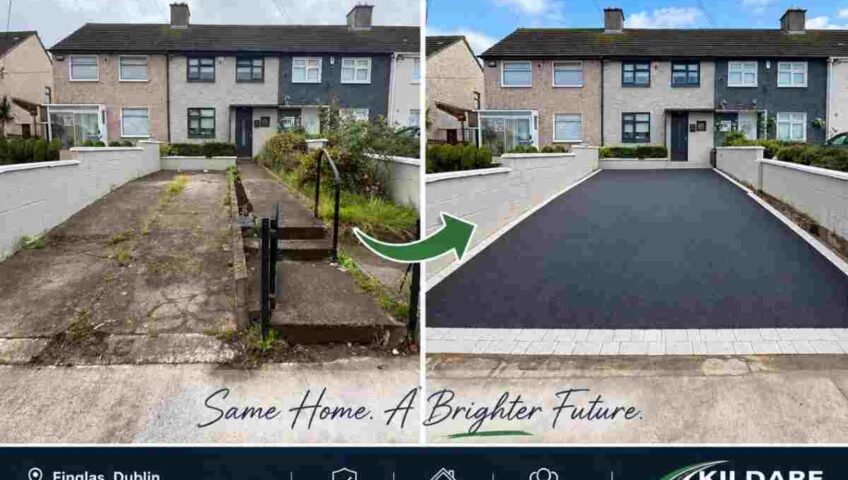
A driveway can look perfectly serviceable through summer and reveal a rather different story once the Irish weather turns.
The first weeks of persistent rain tend to find the weak points: water sitting in shallow depressions, loose edges beginning to crumble, old repairs becoming visible and moss returning to areas that never quite dry. By the middle of winter, a problem that looked minor in September can be considerably harder to ignore.
For homeowners in Dublin thinking about a new tarmac driveway or resurfacing an existing entrance, early autumn is therefore a useful time to take a proper look at what is already there. And if the entrance is being upgraded, it is worth thinking beyond a plain expanse of black tarmac. A simple paving border can make a surprisingly big difference, both visually and practically.
Why Should You Check a Driveway Before the Winter Sets In?
Checking a driveway before winter gives you the chance to spot drainage problems, cracking, weak edges and low areas before months of rain make them worse. Pay particular attention after a heavy shower: where the water goes will often tell you more than looking at the driveway when it’s dry.
Walk the entrance rather than simply viewing it from the house. Look around gates, downpipes, turning areas and places where vehicles regularly park.
A puddle isn’t automatically a serious problem. Water that repeatedly collects in exactly the same place, however, deserves investigation. The same applies to cracks that have widened, crumbling edges or sections that have visibly dropped.
Winter doesn’t necessarily create these weaknesses. It tends to expose the ones already there.
Why Do Tarmac Driveways Work Well for Dublin Homes?
Tarmac remains a practical choice for Dublin homes because it creates a continuous, hard-wearing entrance. It works particularly well for busy family properties and larger areas where paving the entire driveway with blocks may not make sense.
SMA tarmac is increasingly familiar on residential entrances too. Its neat, dark finish works with everything from newer houses around Lucan and Loughlinstown to detached suburban homes where the driveway has to cope with several vehicles, deliveries and regular daily traffic.
The more important question is whether the existing entrance can be resurfaced or needs more extensive groundwork.
If the underlying structure is sound, resurfacing may be possible. If sections are sinking, drainage is poor or the base has failed, putting another layer over the problem isn’t much of a solution.
How Can a Paving Border Improve a Tarmac Driveway?
A paving border can give a tarmac driveway a defined edge without the cost or visual weight of paving the entire entrance. It works particularly well around curved driveways, entrance gates, parking areas and the approach to the house.
We’ve seen the combination work well on residential properties: dark SMA or tarmac through the main driving area, with cobblelock or block paving used to frame it. On a country property, the border can also provide a useful transition between the driveway, lawn and planting.
It doesn’t need to be ornate. In fact, the quieter designs often work best.
A straightforward border in a colour that relates to the house, entrance pillars or existing paving can make the whole front of the property feel more considered.
What Does a Tarmac Driveway Cost in Dublin?
The cost of a tarmac driveway in Dublin depends on the size of the area, existing ground conditions, excavation required, drainage, access, the chosen surface and whether paving borders or kerbing are included. It’s difficult to put a meaningful figure on a job without seeing what is already there.
A straightforward resurfacing job over a sound existing base is very different to lifting an old entrance, correcting levels, installing drainage and constructing a new base before the tarmac is laid.
A paving border will add to the initial cost as well. How much depends on the blocks selected, the amount of edging required and the complexity of the layout.
The useful question isn’t simply, “What’s the price per square metre?”
Ask what that price actually includes.
Two quotations for the same-sized driveway can differ because they describe two very different jobs underneath the finished surface.
Can Spending More on Groundwork Save Money Later?
Laying a fresh surface over a problem that is already visible can be a false economy. If water is pooling, sections are sinking or the existing base is unstable, those issues need to be understood before money is spent on the finish.
Older Dublin properties are particularly interesting in this respect. Entrances may have been widened, patched and altered several times over the years. You occasionally lift an old surface and discover rather more history underneath than expected.
That’s why a site assessment matters. The aim isn’t to specify the most expensive job; it’s to establish what actually needs doing and what can reasonably be retained.
Why Is Drainage Worth Thinking About Before Winter?
Drainage becomes much easier to understand once autumn rain arrives. Watch where water travels during a proper downpour and you’ll quickly identify low points, blocked channels and areas where runoff is heading towards the house rather than away from it.
If resurfacing is being considered, it’s the right time to look at those levels too. This applies whether the finished entrance will be SMA tarmac, standard tarmac or a combination of tarmac and paving.
The prettiest entrance in Dublin will become irritating fairly quickly if you’re stepping through the same puddle every morning from November to February.
Sometimes the most valuable improvement to a driveway is the one you barely notice when the job is finished.
When Should You Consider Resurfacing Rather Than a New Driveway?
Resurfacing can make sense when the existing driveway has a stable base but the upper surface has become worn or tired. More extensive reconstruction may be needed where there is widespread sinking, substantial deterioration or underlying drainage and structural problems.
There isn’t a useful rule based purely on the age of the driveway.
We’ve seen older entrances with perfectly serviceable foundations and newer ones where underlying issues need attention. The condition on the ground is what matters.
For homeowners in Dublin considering resurfacing, that distinction can also make a substantial difference to cost. There is little point paying for excavation that isn’t required, just as there is little value in resurfacing a base that is already failing.
What Should a Good Winter-Ready Entrance Actually Look Like?
A good winter driveway doesn’t need to be elaborate. It should drain properly, feel solid under vehicles, have secure edges and provide straightforward access to the house in wet weather.
Tarmac with a paving border gets that balance right for many Dublin properties. The tarmac deals with the working area while the paving adds some definition between the entrance, house and garden.
Come winter, though, the less glamorous details earn their keep. Water has somewhere sensible to go. Edges remain defined. The entrance is easy to sweep and maintain, and you’re not watching an existing crack or sunken patch deteriorate with every spell of heavy rain.
If you’re considering a new tarmac driveway or resurfacing an older entrance in Dublin, have a look at it after the next heavy shower — it may tell you exactly what needs attention before winter.